27 February, 2024
Cayo Coco - Jagüey Grande - Havana
I was awake early and discovered that the issue with water was ongoing. There was barely enough to flush the toilet and not a drop could be coaxed out of the shower.
We all had a good breakfast and then got ready to move on! Havana beckoned.
It was a little more than three hours before stopping in Santa Clara for lunch. The name of the restaurant eludes me but it is of an exceptionally high quality and the food was terrific. I was especially delighted that they had beets, a firm favourite of mine, and to the best of my recollection the first time I have seen them in Cuba.
It was not long after getting back on the road that we heard a loud bang and Jovani pulled over onto the shoulder. We had blown a rear tyre! We limped along at a much reduced speed, and another Transtur bus stopped ahead of us to see what assistance might be rendered. The best they could do was to transfer some tools and equipment, but Jovani was clearly concerned.

We had planned to stop briefly in Jagüey Grande to visit Tania's parents, but our stay would of necessity be extended to permit a new tyre to be installed.

It was sheer joy to once again be at Tania's delightful home.

The garden is very appealing, reflecting the nature of Cuba in many ways.

There is a tradition in Cuba that when a baby girl is born rum is mixed with fruit and topped up from time to time, and only drunk on the fifteenth birthday of the child. Rocío is now seventeen, but the rum has only improved with age, of that I am quite sure.

I have no doubt that Alan bestowed upon it his seal of approval. I know I certainly did! Looks like Beth was enjoying the moment too!
Rocío has become an enormously talented and creative young lady. This is a mural she painted above an outdoor sink; it would make doing the dishes a pleasure!

Rocío made coffee for us, Tania brought in little bread rolls - I was beginning to rejoice in our blown tyre!
Everything about this home is charming.


Charming inhabitants too.
.jpg)
It wouldn't be hard to figure that Tania is a birder and a photographer.

Soon help was on the way in the form of a giant repair vehicle, with a friendly driver to assure us that all was under control.
.jpg)
We were glad to see him and his huge truck.


It took little time before the bus was raised and people were busy changing the tyre.


I am not sure whether Alan is looking down in despair or bemusement, wondering what might happen next.

In short order, however, the bus was lowered to the ground and we were ready to motor onwards to Havana.
I was happy to display a painting Rocío had presented me with for my birthday.

We noticed that every day is laundry day in Cuba, and when the weather is mostly warm and sunny, why not?
.jpg)
Perhaps Tania thought that her charges might be hungry on the journey to Havana so she stopped to buy cookies.
%20(1).jpg)
Even a disaster had turned into a very pleasant afternoon.
There were many fires along the highway, with smoke and the darkness that comes with it.

No part of the globe it seems is immune from this scourge. Politicians continue to ignore the scientists and everyone pays the price.
.jpg)
.jpg)
%20(1).jpg)
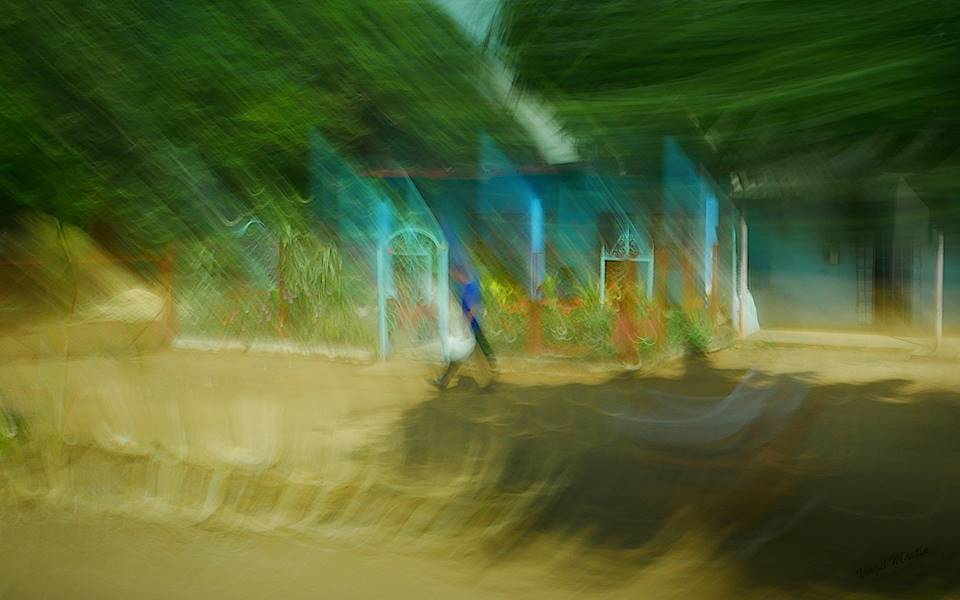
Both Kathy and Virgil produced incredibly interesting and appealing artwork from their photographs.
.jpg)
I am in awe of their talents and the results they achieve.


We arrived in Havana after 21h:00 and went to dinner immediately after checking into our rooms at Hostal Azul Habana.
Katie, the young lady on the front desk is always there to welcome us and to provide impeccable assistance with a broad smile.

We invited her to join us for dinner across the street at Habana 61.

It was indeed a pleasure to have her along.
Thanks to Beth, Kathy and Virgil for sharing their pictures.


.jpg)


.jpg)


.jpg)
.jpg)
.jpg)

.jpg)

.jpg)
.jpg)




.jpg)